


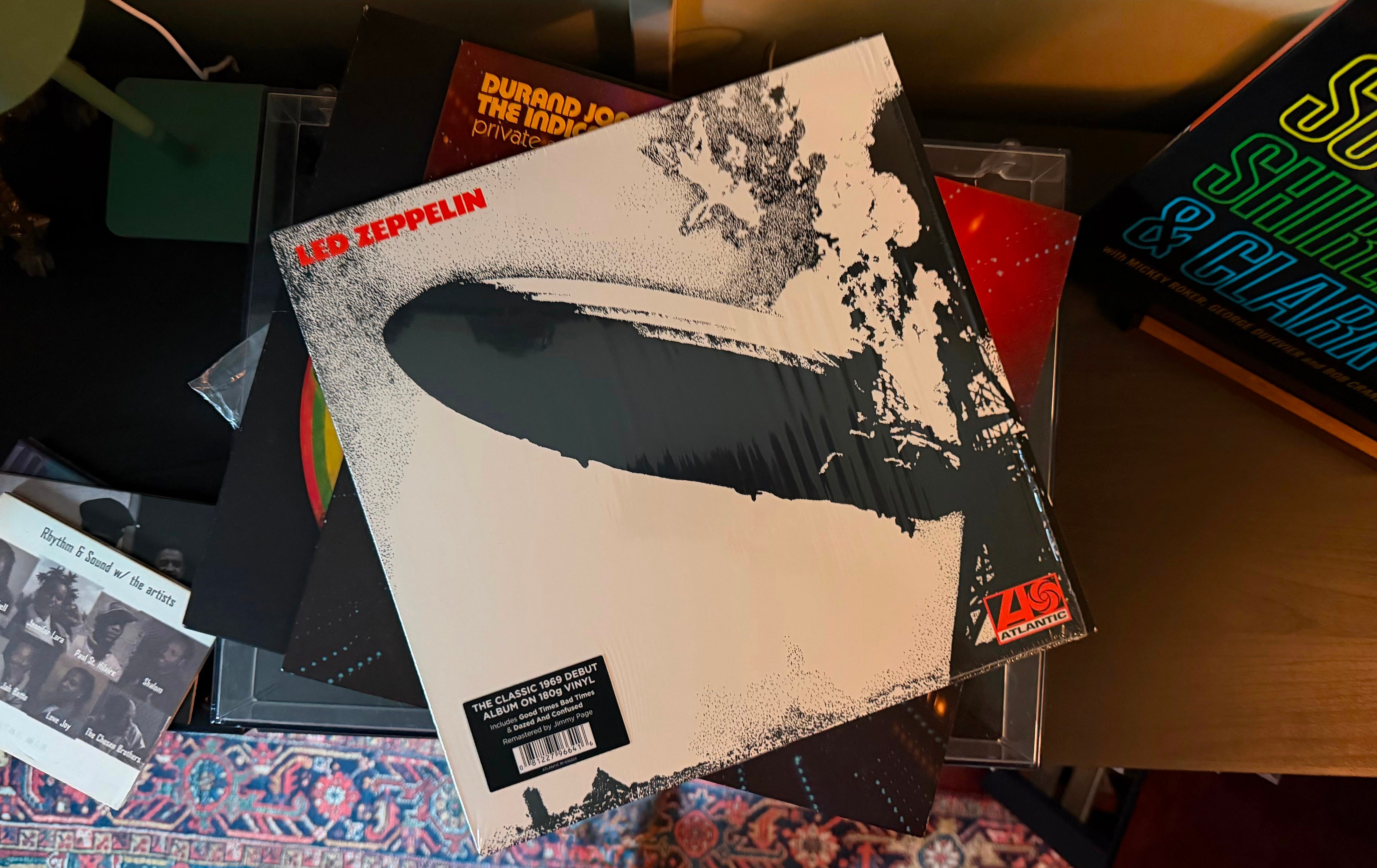
The drive to the office on the first morning of September, a Caffe Kiliim coffee in my cupholder, and the beginning of Zep-tember: a whole month exploring Led Zeppelin and all their albums and offshoots. I know that some classic rock radio station probably beat me to that pun by about thirty years, but I’m using it anyway. Let’s begin…
Led Zeppelin I (Atlantic Records, 1969)
The debut album by this legendary quartet began as soon as I hit Route 95 South, and by the second song I was singing every word out loud, words I hadn’t thought about since I was in high school. I was also banging my hands on the steering wheel and probably looking like I was going mad to my fellow drivers.

Here’s what really blows my mind about this record now that I’m in my 50s instead of a kid with a cassette. The album was made on Jimmy Page’s own dime! He had an idea and no label money. Page and his manager Peter Grant paid for the sessions before the band had a deal with Atlantic Records. Glyn Johns was an engineer on the record, and I don’t think he got a credit, at least not on any of the original pressings.
Now, I think each track on this debut record shines in its own distinct way. Every track is special, and I love each one for different reasons, but two songs stand out to me more than the others.
‘Your Time Is Gonna Come’ opens with John Paul Jones on a Hammond M-100 and Page playing a Fender 10-string pedal steel. In my opinion, Jones gets shorted in every Zeppelin discussion. It took me watching the documentary about Led Zeppelin to realize he was a working session arranger before he joined this band. All the arrangements land because he knew how to build them. He was so much more than just the brilliant bassist.
‘Babe I’m Gonna Leave You’ isn’t a traditional folk song, but it isn’t Page’s either. Anne Bredon, a student at Berkeley, wrote it in the late 1950s, and Joan Baez recorded it first for a live album in 1962, and the credit read “traditional.” Zeppelin heard the Baez version, cut their own, and put “Trad. arr. Page” in the liner notes. Bredon didn’t realize this until the 1980s, and all pressings since then have credited her, not to mention some back royalties that were well due.
That Gibson SJ-200 opens into the flamenco-style guitar, along with Jones's simple but effective bassline, and then Bonham’s explosive percussion enters, and we move to Robert Plant’s voice going straight through the roof. I just love this combination of sound and how Led Zeppelin keeps this song tied to its roots as a folk song. It goes from quiet to loud and then quiet again. It’s just an absolute masterclass in rock ‘n roll.
I remember buying this cassette at the Newington Mall at the Musicsmith, and I believe it was worn out on my Sherwood tape deck before I graduated high school. Back then, more than half the references went over my head, but I just loved how it sounded. During the morning commute, every word came back to me, which felt a little bit strange.
By the way, John Bonham is my pick for the best drummer rock has ever produced. He plays like a jazz drummer who took a job in a rock band. I simply love his technique, his sound, and his style. I know others will argue and mention Keith Moon, Ginger Baker, and Neal Peart, which makes sense, but for me it’s always John Bonham.
Okay, so their debut album included nine songs, all important, and the closer, ‘How Many More Times,’ hits on so many genres, including blues, jazz, psychedelia, and even a funk drum break. It runs over eight minutes. When’s the last time you listened to this song?
This record was made almost 57 years ago, and it cost about two thousand pounds to create, yet it still sounds more contemporary than most records made for two million. We didn’t even talk about how amazing the sound and arrangement on Dazed and Confused is, did we?
Zeppelin II is up next! 😎
What’s your Zep-tember pick, and am I wrong about Bonham? I don’t think I am.
And Zeptember it shall be forever more. Excellent deep dive, Mr. Boucher.
BEST HANDS DOWN? No.
That’s a triumvirate- Bonham, Peart, Moon; no clear #1.